
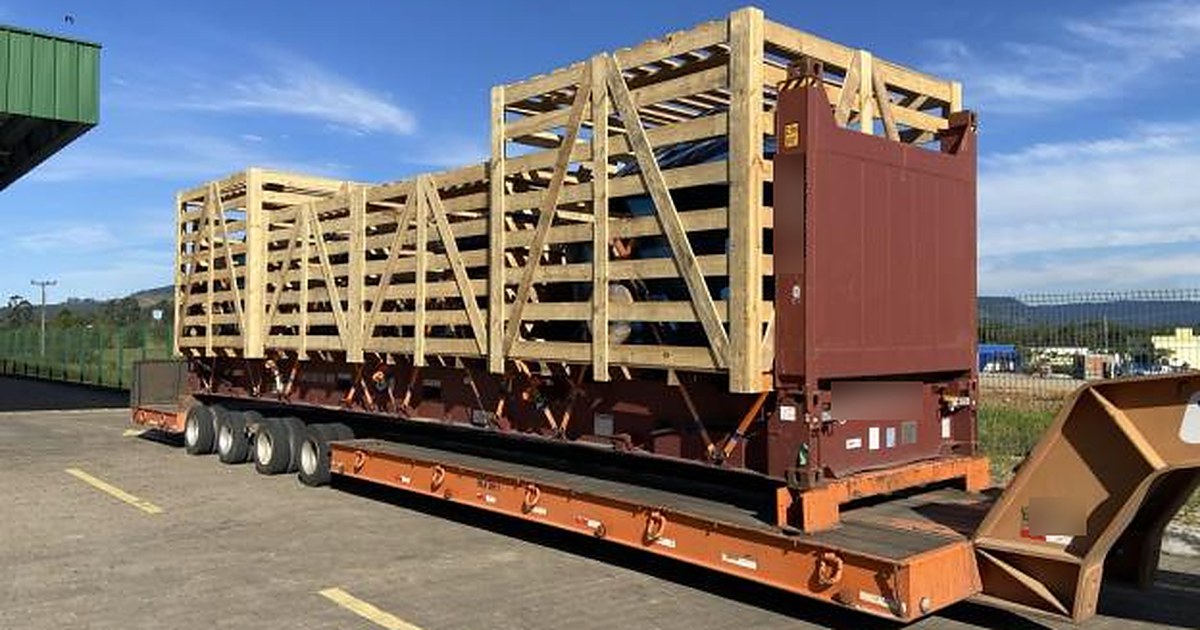
Cargo Securing Certificate (Lashing Certificate) for Flat Rack
How a cargo securing certificate for a flat rack is prepared: lashing plan, calculation report, field inspection, OOG cargo and ART.
Cargo securing on a flat rack
Machinery and equipment that will not fit in a closed container ships on a flat rack, a platform with end frames at each end and no side walls or roof. The cargo is exposed to wind and to the full acceleration of the voyage, and what holds it in place is the straps, the ratchets and the way it was stowed. For this reason shipping lines, terminals and the ship's master often require a lashing plan and an engineer-signed certificate before accepting the cargo for loading, especially when it exceeds the container's gauge.
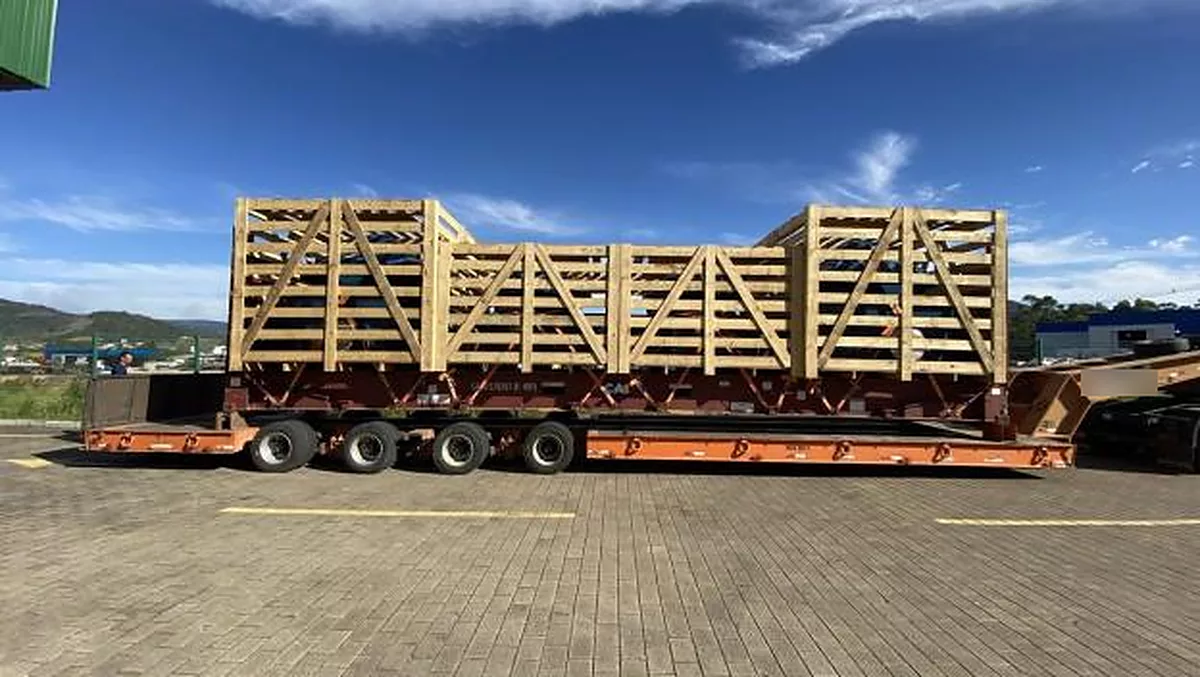
DeltaP Engenharia prepares the lashing plan, the calculation report and the Cargo Securing Certificate (lashing certificate) for exporters, machinery manufacturers and freight agents. Securing motor-driven pumps and other heavy equipment on a flat rack follows the same method, and this article walks through it with photos of a recent case: large motor-pump sets, packed in wooden crates, stowed on a single 40-foot flat rack for export.
What the cargo faces on its way to the ship
The calculation starts from the accelerations the cargo experiences on each leg. For sea transport, the IMO/ILO/UNECE Code of Practice for Packing of Cargo Transport Units (CTU Code) defines the accelerations by sea area. For an unrestricted sea area (area C), the most severe, the cargo is checked for up to 0.8 g in the transverse direction, combined with the vertical acceleration, and 0.4 g longitudinally. The road leg to the port goes into the same calculation, with braking of 0.8 g forward, 0.5 g rearward and 0.5 g sideways. When the flat rack travels on deck, wind on the exposed side area is added.
With these loads, the calculation report checks four situations:
| Check | What is evaluated |
|---|---|
| Transverse sliding | Inertial force and wind against the friction between the crate and the floor, plus the capacity of the straps |
| Longitudinal sliding | Blocking of the row of packages against the steel end frames / headwalls, within the strength stated on the container plate |
| Tipping | The tipping moment about the height of the center of gravity against the restoring moment and the vertical component of the straps |
| Equipment inside the crate | Retention of the machine within its own packaging, with the manufacturer's internal fastening and the external lashing working together |
How the lashing plan is built
- Cargo data: weight, dimensions, height of the center of gravity, type of packaging and fastening points, taken from the manufacturer's drawings and data sheets.
- Flat rack data: CSC approval plate, payload, strength of the steel end frames / headwalls and capacity of the lashing rings.
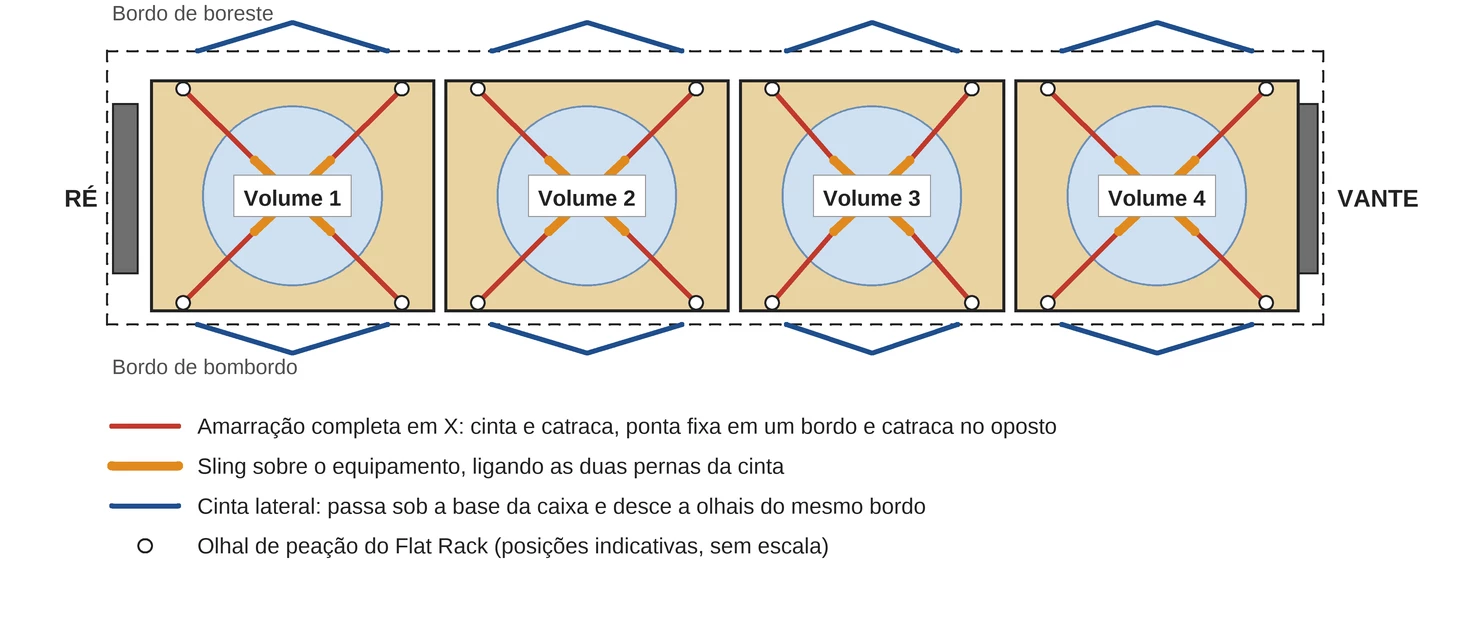
- Position of the packages: the order in which the crates are stowed changes the center of gravity of the row. In the case in this article, one sequence of packages shifted the center of gravity by more than half a meter from the center of the container; changing the order corrected the eccentricity at no cost.
- Strap sizing: each component has a maximum securing load (MSL), and the calculation adopts the lowest value in the chain, which includes strap, ratchet, sling and lashing ring. Shipping lines also ask for a practical check that the sum of the capacities on one side is not less than the weight of the cargo.
- Verification and conclusion: each situation in the table above is given a utilization percentage. In this case no check exceeded 85% of capacity.
The lashing as executed
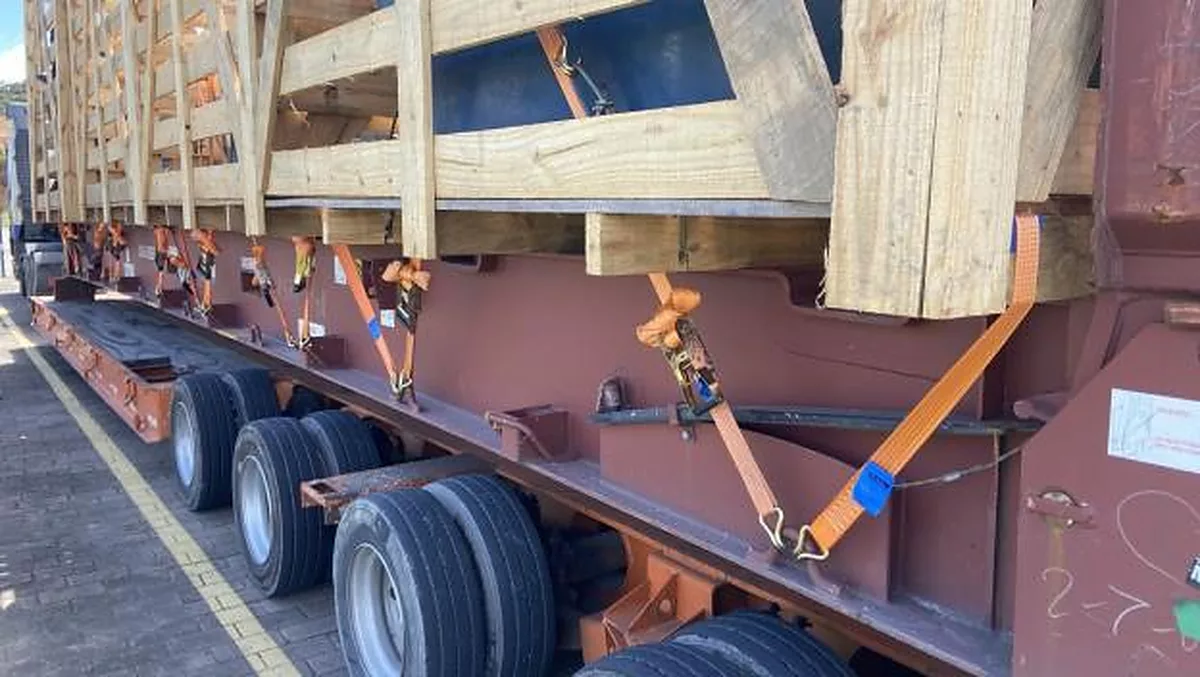
The system combines two independent sets. The first is the full cross (X) lashings, in which the strap connects one side to the other and passes over the equipment through a sling, holding the machine directly to the flat rack and reinforcing the vertical and anti-tipping restraint. The second is the side straps, one per side, which wrap around the base of the crate in the section overhanging the bottom side rail and restrain transverse movement. Longitudinal restraint comes from direct contact between the crates and with the steel end frames / headwalls.
Some execution details are written into the plan because the shipping line requires them and because the inspection checks them:
- do not weld, drill or modify the container;
- avoid metal-to-metal contact, using timber dunnage under the crates and edge protectors;
- do not apply lashings at the end frame points marked as prohibited;
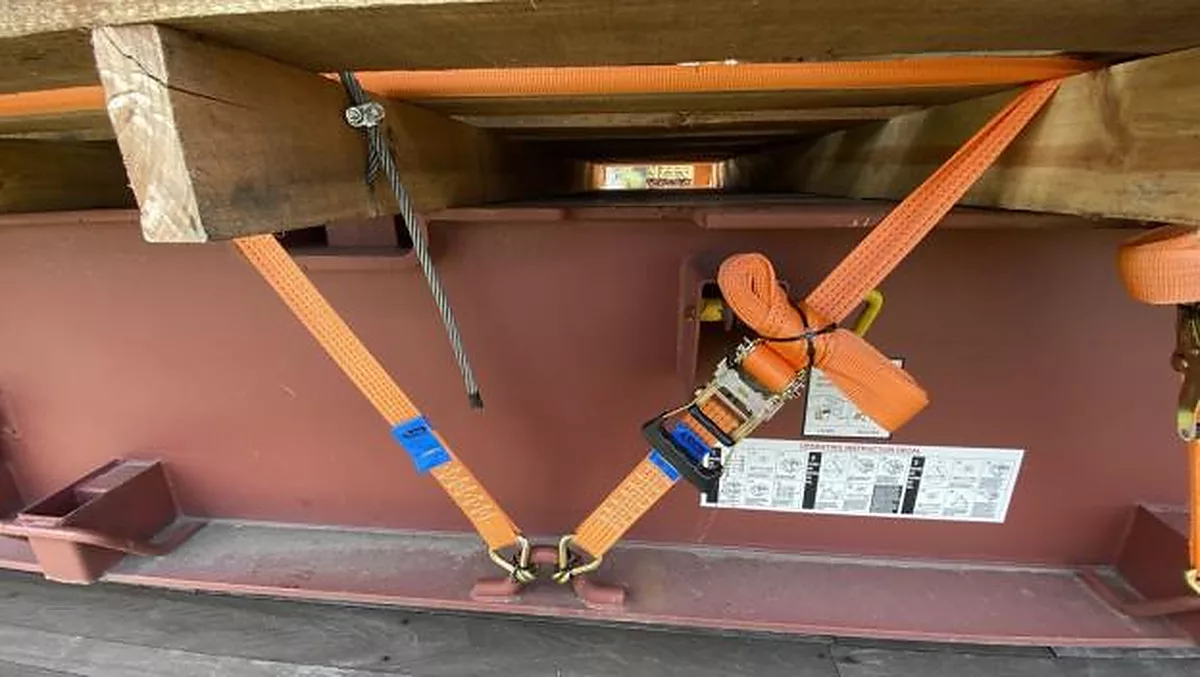
- keep the straps free of knots and twists in the tensioned part, with the loose ends secured outside the load section;
- lock the hooks and keep the ratchets accessible for re-tightening.
The field inspection
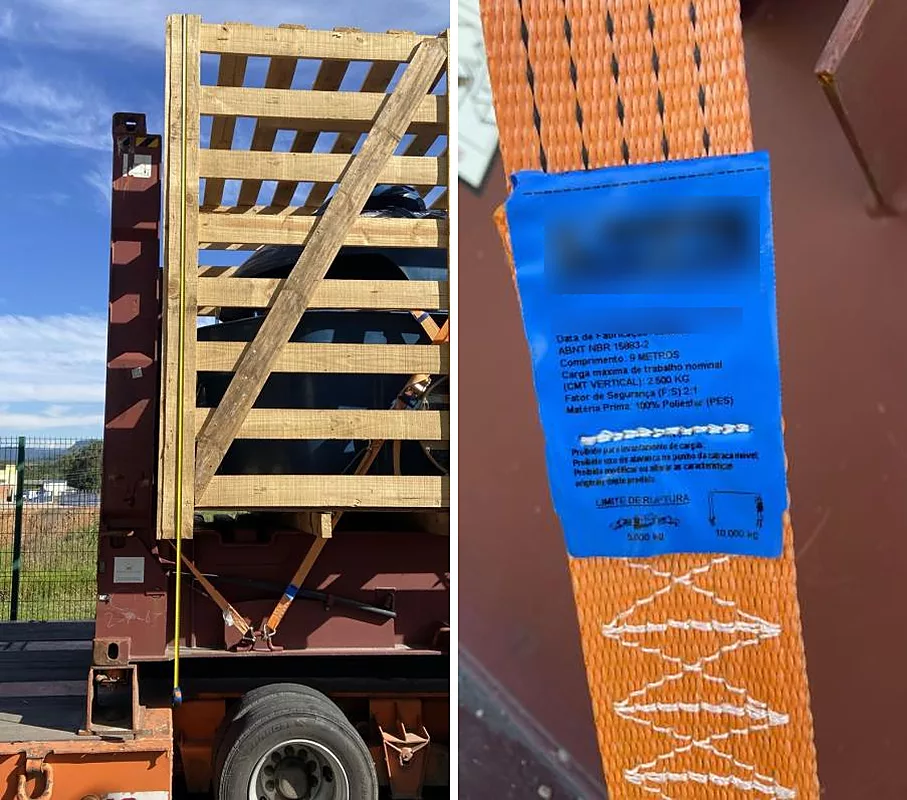
The certificate attests that the actual configuration matches the calculated plan, and for that the engineer goes to the site after the lashing is finished. The inspection checks the position of the packages, the geometry of the straps and the condition of the flat rack, including floor, steel end frames / headwalls, locks, lashing rings and CSC plate. It also records the label of each type of strap, which shows the capacity, the length, the date of manufacture and the traceability code.
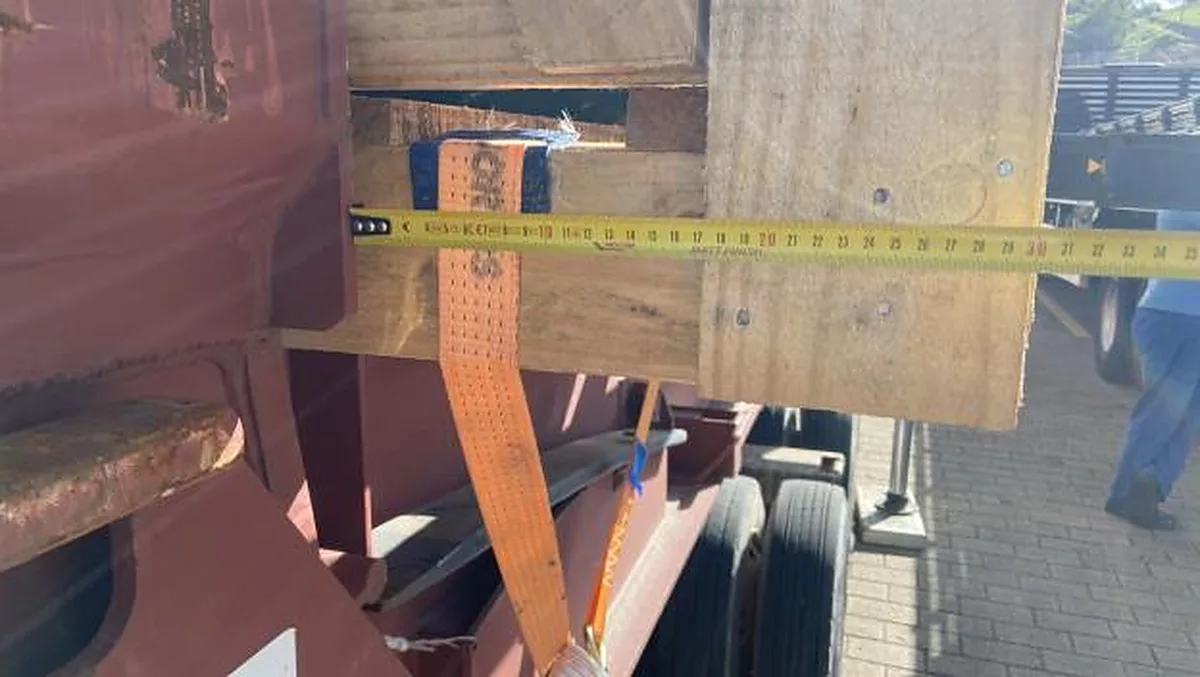
The measurements that feed the calculation are taken with a tape measure on the cargo itself: overhang of the crate beyond the bottom side rail, width and overall height. They define the classification of the cargo and the values declared to the shipping line.
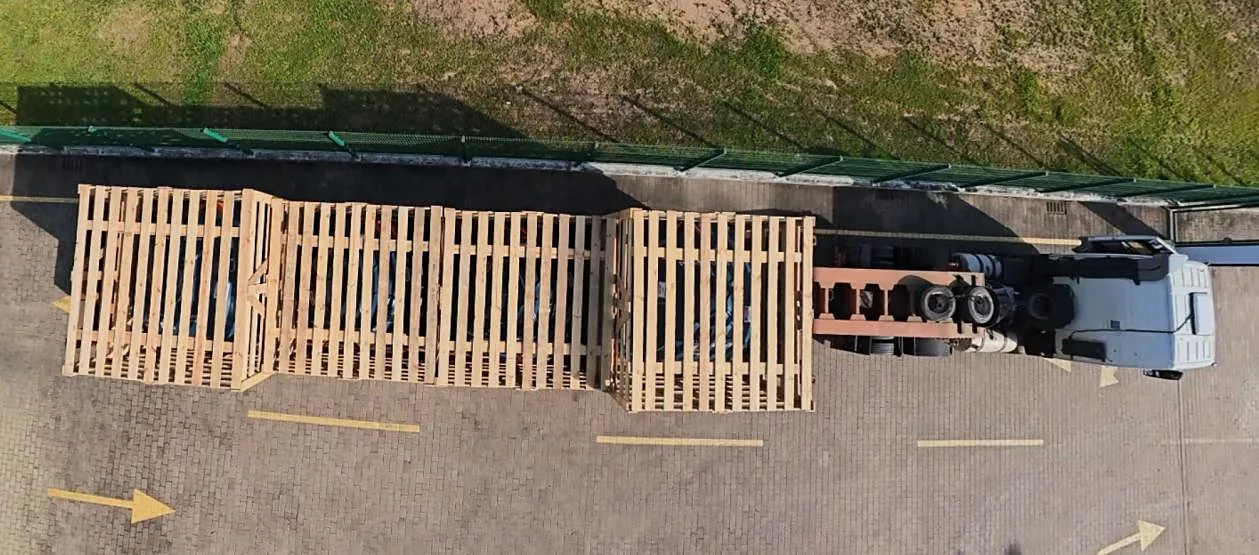
An aerial view helps check the alignment of the row and the distribution of the packages on the platform, and goes into the certificate's photographic record.
Out-of-gauge (OOG) cargo
When the cargo exceeds the width or height of the flat rack, it is classified as OOG (out of gauge). This changes the process: the declared dimensions must include the lashing material, the terminal usually requires acceptance of the cargo before the booking is confirmed, and the shipping line asks for photos, drawings, weights, end frame positions and the lashing certificate. Excess width on the road leg also requires a special transit permit (AET), which is the carrier's responsibility.
For this reason the certificate must be ready before the booking is confirmed. Requesting the lashing after the cargo has already been stuffed leaves little room to correct the position of the packages.
What the certificate contains
The document is issued in Portuguese and English, with an ART (Brazilian technical responsibility record), and includes:
- purpose, scope and standards adopted;
- identification of the cargo, the container and the shipment data;
- lashing plan with sketch and bill of materials, with certificates and labels;
- summary of the calculation report, with the assumptions and the utilization percentage of each check;
- shipping line requirements and the status of each one;
- remarks and limitations;
- inspection data and a conclusion signed by a qualified engineer;
- annexes with the photographic record, the material certificates, the container plate and the manufacturer's drawings.
Limits of the certificate
The certificate is valid for the configuration inspected. Any change of container, position, number of packages, lashing material, route or mode of transport requires a new assessment. The fastening of the equipment inside its packaging and the strength of the crate remain the manufacturer's responsibility, and the data on weight, dimensions and material capacities are those supplied by the client and the suppliers. Final acceptance on board rests with the master, who may ask for additional lashing.
When to hire
The right time is before confirming the shipment, as soon as the cargo data are defined. Hiring is recommended in the following cases:
- first export of a piece of equipment on a flat rack or in an open top container;
- out-of-gauge cargo, where the shipping line and the terminal require documentation;
- heavy, high-value equipment or equipment with a high center of gravity;
- a shipping line, insurer or buyer that asks for the certificate as a condition of shipment;
- recurring shipments of the same product, where part of the lashing plan can be reused.
In the case presented, the time between hiring and issuing the certificate was six days, including the inspection at the plant. The lead time for each job depends on the data sent and on the availability of the cargo for inspection.
Information needed for a quote
- drawings or data sheets of the equipment and the packaging;
- dimensions, weight and center of gravity position of each package;
- capacity of the fastening points and specification of the lashing accessories;
- type of flat rack and, if one exists, the booking with the shipping line;
- photographs of the cargo and of the transport configuration.
References
- IMO/ILO/UNECE Code of Practice for Packing of Cargo Transport Units (CTU Code), MSC.1/Circ.1497
- IMO Code of Safe Practice for Cargo Stowage and Securing (CSS Code), Annex 13, MSC.1/Circ.1352
- International Convention for Safe Containers (CSC, 1972)
- SOLAS Convention, Chapter VI, Regulation 5
- Lashing guides published by shipping lines for flat rack cargo
Technical note: this article is for information only. Accelerations, capacities and lashing conditions depend on the cargo, the container, the route and the shipping line's requirements, and must be verified by a qualified engineer, with an ART, for each shipment.
How to hire
The cargo securing certificate is part of DeltaP's general engineering services. For a quote, send the data above through the contact form and enter "cargo securing" in the message. For insurance and asset control, DeltaP also carries out the appraisal of machinery and equipment.
Need a technical report or project?
Describe the case and send photos. We return with scope, deadline, and value.
Request quotation